Wednesday, February 27, 2008

Water waiting to be released

Ben measures the weight of a snow core near the Alaska-Yukon Territory border

I traveled up the Taylor Hwy in eastern Alaska the past couple of days to help the Bureau of Land Management (BLM) with monthly snow surveys. Snow surveys are performed around Alaska (and the rest of the US) by various agencies during the spring in order to determine the amount of water locked up in the winter snowpack.

In a few months above freezing temperatures will arrive and all of this water in storage will start to melt...and begin its long journey down into the river systems and eventually to the sea. Knowledge of the amount of water stored in the snowpack is important for river and flood forecasting because this will help determine the likelihood and/or severity of spring flooding. In the western US, this type of snowpack information is especially important for water supply planning and determining potential drought conditions.

The Taylor Hwy is closed in the winter so we traveled nearly 200 miles on snowmachines to reach all of the snow survey sites. The Taylor is not really a highway in the general sense...much of it is a narrow dirt road with hairpin turns that connects the Alaska Highway with Eagle, Alaska and Dawson City, Yukon Terr. The road was in great shape because it was being groomed for the International Poker Run - a snowmachine trek between Tok and Dawson City. The road was essentially a 100+ mile ski track...do I see a future ski trip?

So we measured snow depth and snow water equivalent (or the amount of water in the snow if it were melted) at 5 points in a line at what is called a "snow course." All of the snow courses we sampled were established back in the 1960's. This is a relatively long climatological record of the snowpack for Alaska. Snow courses are scattered all around the US. The snow water equivalent can also be measured remotely from aircraft and satellite. I went on a flight last spring that took measurements using airborne gamma radiation (see this post).

The scenery is beautiful along the Taylor Hwy. This is a birds eye view of the Walker Fork of the Fortymile River.

We passed through Chicken on our trip - too bad I wasn't here 3 weeks ago when the temperature bottomed out at -72F (-57.8C) for a few days. It was a balmy +5F (-15C) today.

We spent the night at the "not so" rustic Chicken Field station owned by the BLM.

The "Y" - this is the junction of the Taylor and Top of the World Highways. From here you can either go north to Eagle or east to Dawson City, Yukon.

Frosted willows near the Alaska-Canada border.

The spring sun brightens my view from the snowmachine.

Headed back to the office...

Sunday, February 24, 2008

Re-Doin' Kanuti Hot Springs

Dan and I found at ourselves at Kanuti Hot Springs this weekend ready to soak our tired muscles

It is almost 6 months to the day since our packrafting/hiking trip into Kanuti hot springs back in August (see the previous post: Doin' Kanuti Hot Springs). This time we traversed this remote country which straddles the arctic circle on our skis. We found that a winter ski trip into the springs was far more grueling than our leisurely float down the Kanuti River and hike back out over Caribou Mtn.

Our route started at Milepost 103 Dalton Hwy at the site of a former arctic circle gift shop which sits in the shadow of the Alaska Pipeline. At one time the owner of the shop trapped in this area and back then it was possible to follow part of his snowmachine trail which went toward the springs. No packed trails this year...

My tracked our course. There is no established trail to Kanuti so we went cross country and tried to pick a route that avoided thick brush, trees and deep snow. It was about 11.5 miles from the highway back to the hot springs.

We had a good climb up to the south flanks of Caribou Mtn. There was a great descent after that toward the springs.

Dan skis towards Caribou Mtn in the distance. The snow was windblown and hardpacked the first few miles and made for great skiing because we could glide right along the surface without breaking through into the white abyss below.

We did have to break many miles of trail swimming through waste deep snow and thick brush in places. This was slow and frustrating as our skis and poles got tangled in the spruce, willows and alders. Dan and I would take turns slogging forward in order to give each other a break.

After fighting the deep snow and thick vegetation for a few hours we climbed high on the south flank of Caribou Mtn where the snow was rock hard and scoured away by the wind. There were a lot of rocks too - I quickly broke in my new pair of skis with scratches and dents. oh well...

Yes - happy to be out of the trees and deep snow. The going was easy up high.

We got to the springs before dark. I was surprised it only took us 8 hours to get there considering our achingly slow pace breaking trail. The ground around the springs is so warm that it not only melts the snow - it dries out the ground too. Nice for camping!
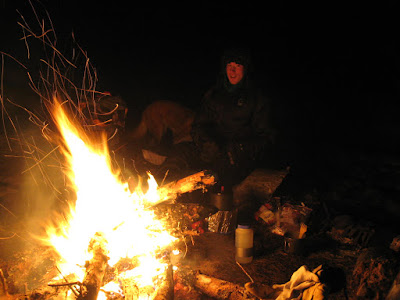
So we set up camp and got a raging fire started before we soaked. It was an awesome night relaxing in the springs as the fire crackled and cast and warm orange glow on the hot water -- and the sound of water trickled down the creek away from the springs. We got the fire going so hot that we were able to spin around in front of it like rotisserie chickens and dry off before slipping our clothes back on and crashing for the night.

The next morning we woke up to a snow storm -- I thought to myself: "Oh no, we might lose our nicely packed trail on the way out."

The snow was quite beautiful though as it delicately coated all the small branches and trees. It lost its beauty some when it came tumbling down onto our heads and down our backs as we broke our way through the brush.

Sky the wonder dog saved us because there were a lot of spots where our trail vanished in the freshly fallen snow - she tracked our trail all the way back to a snow cairn Dan had built to mark our trail into the dense forest.

Damn! We left the dome light on in the car and the battery was completely dead when we returned. After an hour or so we were able to flag down an Alyeska pipeline employee and had him jump it for us. So the lessons learned: 1) make sure all lights are off before departing and 2) always back into your parking spot so someone can reach the battery for a jump.

Sunday, February 17, 2008

Scratched - a mental battle

We're off--100 miles into the Alaskan wilderness.

The Susitna 100 took place down near Wasilla this weekend. This is a 100-mile endurance race on backcountry trails where competitors can choose to bike, run or ski. All racers are required to carry 15 lbs of mandatory survival gear including a -20F sleeping bag, sleeping pad, bivy sack or tent, etc, etc.

The trail conditions and weather were brutal at times--strong head winds, blizzard conditions, a dump of snow, and many miles of blown over and drifted trail. This year the course was far more challenging than in 2006 when we were battered by heavy rain, wet snow and winds. In 2006 the trail was hard packed and fast despite the hypothermia inducing weather conditions. A large percentage of people scratched during this years race and many others didnt even attempt to start. For those that did finish, the overall times this year were some of the slowest ever in the races history.

Kristen and I sort out our food the night before the race. Fritos are one of my secret endurance race snacks--and only 3 ingredients: corn, oil and salt. No preservatives. Salt...yum...

This is actually one of the very few wider sections of trail that wasn't drifted. Much of the course required a lot of double poling and marathon skiing (pushing with one foot) because the trail was soft and narrow. The trail was much better suited for old school classic skiing rather than skate skiing. It was easy to catch my tips on the edge of the trail and tumble face first into the snow.

Ground blizzard on Flathorn Lake - this was the view as we came out onto the lake near the first checkpt. I thought to myself : Holy crap! are people really going to continue into this? They did so I pushed forward... Conditions actually worsened in the aptly named "Dismal Swamp" where 30+ mph headwinds blew the snow around and completely obscured the visibility. This is the point where Kristen bagged it and headed back. (picture stolen from Up in Alaska blog)

So I continued on to the Eaglesong checkpoint at mile 44. About 2 miles out my pole punched several feet into the soft snow. As I fell onto the submerged pole it exploded from my weight and when I pulled it from the snow I found that I had a 3 foot carbon fiber shaft dangling from my wrist - it split in half. I was able to limp my way into Eaglesong with one pole. The folks at the checkpt found an old retro bamboo pole in a shed that was about a foot shorter than my remaining good pole.

Word on the trail was that conditions ahead were bad but after some food and rest I decided to keep going. So I headed out into the late evening darkness and within a mile or so the strap on the newly acquired bamboo pole shredded to pieces. I attempted repair it in the field but it was too far gone and I went back to Eaglesong. I fixed the strap but at this point I had to make a difficult decision: !!Scratch!! - I did it. And now I was going to have to be content with this decision. At the time it seemed more logical to return to the start line on a trail I knew rather than heading into the unknown with what seemed to be an unreliable pole. So I left Eaglesong around midnight and got back to the start around 10 AM. 82 miles and 25 hours later I found myself back where I had started feeling somewhat disappointed and conquered.

Back at the start/finish with the bamboo pole and broken carbon fiber pole.

So I am still suffering from a bit of "scratchers remorse" because I feel like I should have made one last attempt and push forward with the old bamboo pole. I was able to make it back to the starting line without any mishaps so I should have easily been able to complete the course. I suppose its easy to think this from the comfort of home--which is a totally different mindset from being out on the trail, in a snowstorm, frustrated with malfunctioning equipment, stories of horrendous trail conditions ahead, and the uncertainty that the retrofitted pole will hold up. At the time it certainly felt like the most reasonable decision and I guess that is what really matters. With a look on the positive side...I do feel like I am walking away from this race with more confidence in my ability grind on through taxing conditions, I acquired some new techniques for skiing over rough trails, I will always carry an extra pole on extended trips, and I appreciate the opportunity to be out in some beautiful country under grueling conditions.

Saturday, February 9, 2008

A Cold Start to the Yukon Quest

They're off! One of the first teams heads down the 1000-mile trail to Whitehorse, Yukon.

The Yukon Quest sled dog race started on the Chena River in downtown Fairbanks this morning in the crisp -40F (-40C) air and bright pre-spring sunshine. About 25 mushers headed out into the Alaskan bush in one of the toughest races that traverses several mountain ranges, the Yukon River, and some of the coldest valleys in North America. It will take the teams 10-days or more of sleepless nights to reach Whitehorse, Yukon in Canada.

Veteran racer and Yukon Quest and Iditarod champion Lance Mackey departs the start line. The race start was packed with spectators even though the temperature was some 70 degrees Farenheit below the freezing point.

A group of us walked to the race start from Dea and Bens house through the thinning ice fog.

We were all decked out in our warmest arctic clothing as we posed downtown on the Chena River

Friday, February 8, 2008

Urban Contrails

The University powerplant exhales a steady stream of warm, moist air into the -50F (-46C) arctic atmosphere.

Fairbanks has been swallowed by a sea of dense ice fog the past few days as the thermometer plummeted well below zero. Powerplants, vehicles and anything else that emit water vapor into the atmosphere at these temperatures create a gritty, grey layer of fog that gradually thickens until warmer air arrives. Ice fog is a different breed of fog. It develops around -40F when nearly all supercooled water vapor ceases to exist in the atmosphere...and any moisture in the air becomes entirely composed of ice. So--the fog turns the city into an opaque world where the visibility drops down to near-zero for days on end.

Vehicles essentially create urban contrails--similar to a jet flying at 35,000 feet--that never dissipate. Driving is extremely treacherous under these conditions because the car in front of you can easily become completely obscured by the cloud of steam ejected from the exhaust pipe.

Fairbanks is burried by a sea of ice fog--while the University situated up on a hill basks in crisp clear skies. Driving into the city is like descending into a murky cespool. During long periods of extremely frigid weather the fog is relentless and will remain over town until the cold spell breaks.
The ice fog is mysteriously beautiful from above.

Thursday, February 7, 2008

Eternal Frost

The thermometer bottoms out at Obrien Creek near Eagle, Alaska (Larry Taylor photo)

Deep cold gripped Alaska and the Yukon this week. Some of the coldest temperatures reported in North America in nearly 8-years occured the past few days. The weather observer in Chicken, Alaska captured an icy -72F (-57.8C) the past two mornings. This is the coldest official temperature in the US since January 2000, which also occurred in Chicken. This reading is 3 degrees shy of the coldest temperature ever recorded in the US during February. The record for February was -75F (-59.4C) at Tanacross in 1947. And the low temperature reported in Chicken this week is only 8 degrees shy of the all-time record low for the US, which was -80F (-62.2C) set back in January 1971.

This is an infrared satellite image of eastern Alaska and the Yukon Territory. The white pixels represent colder temperatures and the darker pixels are warmer temperatures. This is a fascinating image because you can see that the cold, dense air (white areas) sitting in the valleys. In the upper half of the picture it is possible to make out the dendritic river valleys snaking up into the Brooks Range. The valleys in the Yukon are also clearly visible. The big white area in the middle is the Yukon Flats - a bathtub of cold air. Fort Yukon was reporting -60F when this image was captured. The satellite imagery indicated some of the colder valley locations were reporting temperatures into the -70'sF. Unfortunately, these remotely sensed temperatures are not official since no one was there to actually measure the temperature.

So the temperature plummeted to the -50's F in Fairbanks and I continued my daily routine of commuting to work on my skis. "Are you nuts?"--some may ask. I have found that it takes just as long to warm up the truck and drive. The skis dont need to be plugged in and its much easier on the truck to sit dormant in the driveway. I have been called a freak many times because of my obsession with the cold. Its difficult to convey to people the power and peacefulness of a subzero world. The crisp, dark mornings are something very special to me as the icy air bites my face and fills my lungs with every deep breath--and the last green curtains of aurora dance over my shoulders before being washed away by the first rays of sunlight.

I will end this post with a poem passed on to me by my friend Lena:

Cold Poem

Cold now. Close to the edge. Almost
unbearable. Clouds bunch up and boil down
from the north of the white bear.
This tree-splitting morning
I dream of his fat tracks,
the lifesaving suet.

I think of summer with its luminous fruit,
blossoms rounding to berries, leaves,
handfuls of grain.

Maybe what cold is, is the time
we measure the love we have always had, secretly,
for our own bones, the hard knife-edged love
for the warm river of the I, beyond all else; maybe

that is what it means the beauty
of the blue shark cruising toward the tumbling seals.

In the season of snow,
in the immeasurable cold,
we grow cruel but honest; we keep
ourselves alive,
if we can, taking one after another
the necessary bodies of others, the many
crushed red flowers.

Mary Oliver

Tuesday, February 5, 2008

The bikers...

Tim is ready hit the trail after a night at Tolovona Hot Springs.

Heather and I skied the 11-mile trail out to Tolovana Hot Springs to meet Jeff, Tim and Pete on the first night of their 200+ mile biking circuit along remote trapping/snowmachine trails north of Fairbanks. They left Fairbanks at 5am and headed out into unknown trail conditions. Their first stop was Tolovana Hot Springs--about 80 miles or so from Fairbanks via the dunbar trail. They expected to arrive around dinner time if all went well. Trail conditions deteriorated about 15 miles from the springs and they ended up trudging through soft, punchy snow with their bikes at their sides. The guys woke us up from a sound sleep as they stumbled into the cabin around 3 am.


Check out the giant tires on Jeffs bike - these make it possible to bike through relatively soft snow.
The guys are training for the Iditarod Trail Invitational - a 350-mile ultra race along the Iditarod Trail. The race starts Feb 24th. Keep and eye on their progress by checking out the race website.

Plans changed because the trail was so crummy. The guys ended up riding back to town with us. So we crammed 5 people, 2 dogs, 3 beefy bikes, skis and gear into the car.

Tuesday, January 29, 2008

Up in Flames

The ski lodge at Cleary Summit burns out of control in the dawn light

The lodge at the oldest downhill ski hill in Fairbanks burned to the ground in less than an hour today. The hill closed back in 1993 but the lodge sat vacant as a piece of skiing history the past 15 years. There had been three previous ski lodges at Cleary Summit, all of which had burned to the ground over the years--and now the most recent structure, which dates back to 1960, is a pile of ashes along the Steese Hwy. So today marks the close of the final chapter for the Cleary Summit Ski Area. There are some nice classic pictures of Cleary Summit ranging from the 1940's to the early 1990's on the Alaska Lost Ski Area's webpage.

So why I am I posting this story? What started as a usual day in the field taking monthly ice thickness measurements around Fairbanks had an unusual turn as we drove over Cleary Summit. My coworker and I drove by the ski lodge on the way out to the Chatanika River around 8:30 am and came across an orange truck that had spun out across the road and was stuck in the snowbank adjacent to the Clearly Summit Ski Lodge. There didnt appear to be anyone around so we continued on our way.

About an hour later we passed by again on our way back towards town. From a distance we noticed a very faint whiff of smoke coming from one of the eves of the lodge. It was barely noticeable and we nearly kept on driving. What really caught our attention and seemed rather peculiar was that the passenger door on the orange truck was wide open and partially sticking out into a lane of the Steese Hwy. We stopped to close the door and found that the keys were still in the ignition. Then suddenly we observed two plumes of smoke rising from the lodge. It was obviously on fire and we ran over to see if anyone might be in there. At that time two other guys showed up and went down to the building to investigate as I called 911. We were asked to remain at the scene until a trooper arrived.

The building rapidly went up in flames as the fire spread to the second floor. The structure creaked and moaned as the large wood timbers ignited and the metal roof melted away. A few others pulled over as black smoke belched into the cold air and left a tar-like smear more than a mile long across the horizon. One guy reminisced about eating plate fulls of nachos in the lodge while another commented about all the beers he drank in the historic building that was in its final moments of existence. Another local at the scene said that he had seen the orange truck parked near the lodge on several occasions during the past few weeks and he speculated that someone had been squatting inside. We were just uncertain at the time if this person might still be inside.

Meanwhile the trooper had gone up the road to a place where he could get radio reception. From out of nowhere two vehicles pulled up next to the orange truck and quickly attached a tow-strap to the back bumper. They hauled the orange hunk of steel out of the ditch and attempted to get the thing started. The group of us standing around were not quite sure if this was the owner of the truck and if we should say anything. Seconds later the trooper arrives with his lights flashing and stops to question the guys gathered around the orange truck. We decided it was time to get back to work and we climbed into our vehicle as the old lodge collapsed and became a glowing pile of memories in our rearview mirror.
-------------------------------------------------------
Update as of Thursday, Jan 31, 2008:

So the plot thickened as more information surfaced: stolen vehicle, revoked license, etc. One of the guys that showed up to pull the orange truck from the snowbank was the owner. He apparently smelled like smoke and was wearing some clothing that had been torched. He denied having any connection with the burning ski lodge adjacent to his stranded truck. For the complete story read the article in the Fairbanks Daily News-Miner.

Wednesday, January 23, 2008

A cold day in US history

January 23, 1971: Today marks the 37th anniversary of the official US record low temperature of -80º F (-62.4º C) recorded at Prospect Creek Camp, Alaska.

The 37 year old US record low temperature was captured by a weather observer at the Alaska pipeline construction camp near the confluence of Prospect Creek and the Jim River. The camp has long been dismantled and all that remains is a large gravel pad surrounded by the encroaching boreal forest.

Prospect Creek Camp was located at the bottom of the valley in the distance. This is the winter road to Bettles and the camp was situated near the start of the road.

Snag, Yukon Territory, Canada: -81º F (-62.8º C) - This abandoned airstrip near the Alaska border is the site where the all-time record low temperature for North America was recorded on February 3, 1947. The airstrip was built as part of the Lend-Lease program where US pilots ferried planes to the Soviet Union and other allied nations. Check out Ned's Alaska Science Forum article about Snag, the coldest place in North America.

Oimyakon, Russia: -96ºF (-71.2º C) - This small village in northeastern Siberia holds the record for the coldest temperature in the northern hemisphere. The bone chilling record low occurred on January 26, 1926. There is ongoing debate about this record though since it was apparently obtained by extrapolation because the thermometer didn't read that low. Oimyakon is regarded as the coldest permanently inhabited place on the planet. In January 2004 I visited Valeri, the official weather observer in the village. He is certainly acclimated to the -58ºF temperature as he casually poses with his coat unbuttoned.

The -96ºF recorded at Oimyakon is debatable--but officially, Oimyakon did bottom out at -90º F (-67.7º C) on February 6, 1933. At the weather office in Yakutsk I was blessed with the opportunity to fondle the original handwritten form scribbled on by the observer in 1933. This temperature was actually recorded at the Tomtor airport about 30km away. The village is down the valley and presumably experiences slightly colder temperatures than Tomtor. So the debate over the actual record low will forever continue. Interestingly, the Tomtor airport was another stop for planes along the Lend-Lease route, similar to Snag, Yukon Terr.

Vostok Station, Antarctica: -129º F (-89.4º) - And the coldest temperature ever recorded was measured at the Russian research station located high on the Antarctic plateau on July 21, 1983. (Nope...I didn't take this shot...but maybe some day I will visit Vostok station).