Saturday, February 9, 2008

A Cold Start to the Yukon Quest

They're off! One of the first teams heads down the 1000-mile trail to Whitehorse, Yukon.

The Yukon Quest sled dog race started on the Chena River in downtown Fairbanks this morning in the crisp -40F (-40C) air and bright pre-spring sunshine. About 25 mushers headed out into the Alaskan bush in one of the toughest races that traverses several mountain ranges, the Yukon River, and some of the coldest valleys in North America. It will take the teams 10-days or more of sleepless nights to reach Whitehorse, Yukon in Canada.

Veteran racer and Yukon Quest and Iditarod champion Lance Mackey departs the start line. The race start was packed with spectators even though the temperature was some 70 degrees Farenheit below the freezing point.

A group of us walked to the race start from Dea and Bens house through the thinning ice fog.

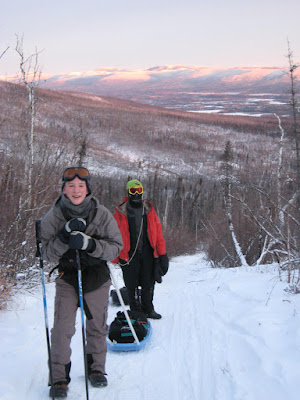
We were all decked out in our warmest arctic clothing as we posed downtown on the Chena River

Friday, February 8, 2008

Urban Contrails

The University powerplant exhales a steady stream of warm, moist air into the -50F (-46C) arctic atmosphere.

Fairbanks has been swallowed by a sea of dense ice fog the past few days as the thermometer plummeted well below zero. Powerplants, vehicles and anything else that emit water vapor into the atmosphere at these temperatures create a gritty, grey layer of fog that gradually thickens until warmer air arrives. Ice fog is a different breed of fog. It develops around -40F when nearly all supercooled water vapor ceases to exist in the atmosphere...and any moisture in the air becomes entirely composed of ice. So--the fog turns the city into an opaque world where the visibility drops down to near-zero for days on end.

Vehicles essentially create urban contrails--similar to a jet flying at 35,000 feet--that never dissipate. Driving is extremely treacherous under these conditions because the car in front of you can easily become completely obscured by the cloud of steam ejected from the exhaust pipe.

Fairbanks is burried by a sea of ice fog--while the University situated up on a hill basks in crisp clear skies. Driving into the city is like descending into a murky cespool. During long periods of extremely frigid weather the fog is relentless and will remain over town until the cold spell breaks.
The ice fog is mysteriously beautiful from above.

Thursday, February 7, 2008

Eternal Frost

The thermometer bottoms out at Obrien Creek near Eagle, Alaska (Larry Taylor photo)

Deep cold gripped Alaska and the Yukon this week. Some of the coldest temperatures reported in North America in nearly 8-years occured the past few days. The weather observer in Chicken, Alaska captured an icy -72F (-57.8C) the past two mornings. This is the coldest official temperature in the US since January 2000, which also occurred in Chicken. This reading is 3 degrees shy of the coldest temperature ever recorded in the US during February. The record for February was -75F (-59.4C) at Tanacross in 1947. And the low temperature reported in Chicken this week is only 8 degrees shy of the all-time record low for the US, which was -80F (-62.2C) set back in January 1971.

This is an infrared satellite image of eastern Alaska and the Yukon Territory. The white pixels represent colder temperatures and the darker pixels are warmer temperatures. This is a fascinating image because you can see that the cold, dense air (white areas) sitting in the valleys. In the upper half of the picture it is possible to make out the dendritic river valleys snaking up into the Brooks Range. The valleys in the Yukon are also clearly visible. The big white area in the middle is the Yukon Flats - a bathtub of cold air. Fort Yukon was reporting -60F when this image was captured. The satellite imagery indicated some of the colder valley locations were reporting temperatures into the -70'sF. Unfortunately, these remotely sensed temperatures are not official since no one was there to actually measure the temperature.

So the temperature plummeted to the -50's F in Fairbanks and I continued my daily routine of commuting to work on my skis. "Are you nuts?"--some may ask. I have found that it takes just as long to warm up the truck and drive. The skis dont need to be plugged in and its much easier on the truck to sit dormant in the driveway. I have been called a freak many times because of my obsession with the cold. Its difficult to convey to people the power and peacefulness of a subzero world. The crisp, dark mornings are something very special to me as the icy air bites my face and fills my lungs with every deep breath--and the last green curtains of aurora dance over my shoulders before being washed away by the first rays of sunlight.

I will end this post with a poem passed on to me by my friend Lena:

Cold Poem

Cold now. Close to the edge. Almost
unbearable. Clouds bunch up and boil down
from the north of the white bear.
This tree-splitting morning
I dream of his fat tracks,
the lifesaving suet.

I think of summer with its luminous fruit,
blossoms rounding to berries, leaves,
handfuls of grain.

Maybe what cold is, is the time
we measure the love we have always had, secretly,
for our own bones, the hard knife-edged love
for the warm river of the I, beyond all else; maybe

that is what it means the beauty
of the blue shark cruising toward the tumbling seals.

In the season of snow,
in the immeasurable cold,
we grow cruel but honest; we keep
ourselves alive,
if we can, taking one after another
the necessary bodies of others, the many
crushed red flowers.

Mary Oliver

Tuesday, February 5, 2008

The bikers...

Tim is ready hit the trail after a night at Tolovona Hot Springs.

Heather and I skied the 11-mile trail out to Tolovana Hot Springs to meet Jeff, Tim and Pete on the first night of their 200+ mile biking circuit along remote trapping/snowmachine trails north of Fairbanks. They left Fairbanks at 5am and headed out into unknown trail conditions. Their first stop was Tolovana Hot Springs--about 80 miles or so from Fairbanks via the dunbar trail. They expected to arrive around dinner time if all went well. Trail conditions deteriorated about 15 miles from the springs and they ended up trudging through soft, punchy snow with their bikes at their sides. The guys woke us up from a sound sleep as they stumbled into the cabin around 3 am.


Check out the giant tires on Jeffs bike - these make it possible to bike through relatively soft snow.
The guys are training for the Iditarod Trail Invitational - a 350-mile ultra race along the Iditarod Trail. The race starts Feb 24th. Keep and eye on their progress by checking out the race website.

Plans changed because the trail was so crummy. The guys ended up riding back to town with us. So we crammed 5 people, 2 dogs, 3 beefy bikes, skis and gear into the car.

Tuesday, January 29, 2008

Up in Flames

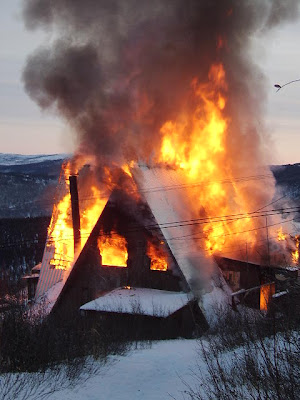
The ski lodge at Cleary Summit burns out of control in the dawn light

The lodge at the oldest downhill ski hill in Fairbanks burned to the ground in less than an hour today. The hill closed back in 1993 but the lodge sat vacant as a piece of skiing history the past 15 years. There had been three previous ski lodges at Cleary Summit, all of which had burned to the ground over the years--and now the most recent structure, which dates back to 1960, is a pile of ashes along the Steese Hwy. So today marks the close of the final chapter for the Cleary Summit Ski Area. There are some nice classic pictures of Cleary Summit ranging from the 1940's to the early 1990's on the Alaska Lost Ski Area's webpage.

So why I am I posting this story? What started as a usual day in the field taking monthly ice thickness measurements around Fairbanks had an unusual turn as we drove over Cleary Summit. My coworker and I drove by the ski lodge on the way out to the Chatanika River around 8:30 am and came across an orange truck that had spun out across the road and was stuck in the snowbank adjacent to the Clearly Summit Ski Lodge. There didnt appear to be anyone around so we continued on our way.

About an hour later we passed by again on our way back towards town. From a distance we noticed a very faint whiff of smoke coming from one of the eves of the lodge. It was barely noticeable and we nearly kept on driving. What really caught our attention and seemed rather peculiar was that the passenger door on the orange truck was wide open and partially sticking out into a lane of the Steese Hwy. We stopped to close the door and found that the keys were still in the ignition. Then suddenly we observed two plumes of smoke rising from the lodge. It was obviously on fire and we ran over to see if anyone might be in there. At that time two other guys showed up and went down to the building to investigate as I called 911. We were asked to remain at the scene until a trooper arrived.

The building rapidly went up in flames as the fire spread to the second floor. The structure creaked and moaned as the large wood timbers ignited and the metal roof melted away. A few others pulled over as black smoke belched into the cold air and left a tar-like smear more than a mile long across the horizon. One guy reminisced about eating plate fulls of nachos in the lodge while another commented about all the beers he drank in the historic building that was in its final moments of existence. Another local at the scene said that he had seen the orange truck parked near the lodge on several occasions during the past few weeks and he speculated that someone had been squatting inside. We were just uncertain at the time if this person might still be inside.

Meanwhile the trooper had gone up the road to a place where he could get radio reception. From out of nowhere two vehicles pulled up next to the orange truck and quickly attached a tow-strap to the back bumper. They hauled the orange hunk of steel out of the ditch and attempted to get the thing started. The group of us standing around were not quite sure if this was the owner of the truck and if we should say anything. Seconds later the trooper arrives with his lights flashing and stops to question the guys gathered around the orange truck. We decided it was time to get back to work and we climbed into our vehicle as the old lodge collapsed and became a glowing pile of memories in our rearview mirror.
-------------------------------------------------------
Update as of Thursday, Jan 31, 2008:

So the plot thickened as more information surfaced: stolen vehicle, revoked license, etc. One of the guys that showed up to pull the orange truck from the snowbank was the owner. He apparently smelled like smoke and was wearing some clothing that had been torched. He denied having any connection with the burning ski lodge adjacent to his stranded truck. For the complete story read the article in the Fairbanks Daily News-Miner.

Wednesday, January 23, 2008

A cold day in US history

January 23, 1971: Today marks the 37th anniversary of the official US record low temperature of -80º F (-62.4º C) recorded at Prospect Creek Camp, Alaska.

The 37 year old US record low temperature was captured by a weather observer at the Alaska pipeline construction camp near the confluence of Prospect Creek and the Jim River. The camp has long been dismantled and all that remains is a large gravel pad surrounded by the encroaching boreal forest.

Prospect Creek Camp was located at the bottom of the valley in the distance. This is the winter road to Bettles and the camp was situated near the start of the road.

Snag, Yukon Territory, Canada: -81º F (-62.8º C) - This abandoned airstrip near the Alaska border is the site where the all-time record low temperature for North America was recorded on February 3, 1947. The airstrip was built as part of the Lend-Lease program where US pilots ferried planes to the Soviet Union and other allied nations. Check out Ned's Alaska Science Forum article about Snag, the coldest place in North America.

Oimyakon, Russia: -96ºF (-71.2º C) - This small village in northeastern Siberia holds the record for the coldest temperature in the northern hemisphere. The bone chilling record low occurred on January 26, 1926. There is ongoing debate about this record though since it was apparently obtained by extrapolation because the thermometer didn't read that low. Oimyakon is regarded as the coldest permanently inhabited place on the planet. In January 2004 I visited Valeri, the official weather observer in the village. He is certainly acclimated to the -58ºF temperature as he casually poses with his coat unbuttoned.

The -96ºF recorded at Oimyakon is debatable--but officially, Oimyakon did bottom out at -90º F (-67.7º C) on February 6, 1933. At the weather office in Yakutsk I was blessed with the opportunity to fondle the original handwritten form scribbled on by the observer in 1933. This temperature was actually recorded at the Tomtor airport about 30km away. The village is down the valley and presumably experiences slightly colder temperatures than Tomtor. So the debate over the actual record low will forever continue. Interestingly, the Tomtor airport was another stop for planes along the Lend-Lease route, similar to Snag, Yukon Terr.

Vostok Station, Antarctica: -129º F (-89.4º) - And the coldest temperature ever recorded was measured at the Russian research station located high on the Antarctic plateau on July 21, 1983. (Nope...I didn't take this shot...but maybe some day I will visit Vostok station).

Sunday, January 20, 2008

A traverse through the White Mountains

Dan, Sky and Asia head towards the jagged limestone peaks of the White Mountains

Wow--we are experiencing some dynamic weather in Alaska this week. Temperatures rebounded by 70 degrees Fahrenheit in the past 5 days. It was a chilly 40 to 50 degrees below zero early last week and now we are baking as the thermometer soared to 20 to 30 degrees above zero. The warmer temperatures and fresh snow made for a great weekend to do a long traverse through the heart of the White Mountains.

Dan and I skied 65-mile route which included a night at the Borealis and Wolf Run Cabins. You can see from my gps profile we had an overall net loss in elevation but did get to climb a few hills along the way. We covered the entire route without seeing a single person all weekend...ahhh...

The early-afternoon sun sheds a warm glow on the Borealis Cabin. We departed Fri evening for the 20-mile ski to the cabin. We didn't hit the trail on Saturday until the crack of noon.

Most of the cabins are all setup with a table, stoves/lanterns, and plenty of places to crash at night.

The trails in the White Mountains have been pretty crappy due to the low snow this year. A healthy dump of snow a few days ago greatly improved conditions. The tussocks and deep trenches between them were finally getting filled in with snow and the trail was in pretty good shape. We ended up breaking trail for about 30-miles which made the going a little slower than normal.

Here is the junction to the Caribou Bluff cabin and the beginning of the Fossil Gap trail--which cuts right through a jagged ridge of limestone. This section of trail is quite scenic.

There were wolf and moose tracks all over the place near fossil gap. From the mess of tracks we figured something had gone down and we speculated that the wolves were likely stocking a moose.

A knife-like limestone ridge rises above Fossil Creek.

A nearly full moon illuminates the peaks above Beaver Creek. This is an unusual stretch of river because it was still unfrozen even in mid-winter. We didn't stop for too long because the wind was howling and the temperature had rapidly dropped to -5 F.

A picture perfect view from the Wolf Run Cabin

Some sections of the trail were open meadows and exposed to the wind

Dan reveals his secret to skiing miles and miles all day...

And a long ski trip is never complete without out eating a completely disgustingly fattening meal from Hill Top truck stop on the way back into town.

Sunday, January 13, 2008

Cold air...warm cabin

The late morning light reflects in the window of Moose Cr Cabin

It was a chilly weekend in Fairbanks with temperatures hovering between 20 and 30 below zero F. An invigorating bite to the air, the eternal frost covering the landscape, and the subtle pastels of the mid-winter sky made it all too alluring for me to head out of town to a cozy cabin tucked back in the White Mountains north of Fairbanks. Dan, Sky and I skied out under a star filled sky Fri evening with our headlamps illuminating our way.

A dog musher headed deeper into the wilderness passes us on the trail.

Dan and Sky are ready to hit the trail. With only a few layers on we remained comfortably warm if we kept moving but the moment we stopped to stuff food into our mouths our core body temperature would instantly plummet. So we maintained a pace that was just intense enough to keep us warm but not hard enough to get really sweaty.

At these temperatures vehicles don't like to work unless they are plugged in or resting in a warm garage. So it took us about 45 minutes to heat up the engine block using a propane fired weed burner torch and a stove pipe.

Tuesday, January 1, 2008

A New Year begins at Tolovana Hot Springs

My 13 year old nephew Mark-E admires the view at the beginning of the 11-mile ski to Tolovana Hot Springs

2007 came to nice close as I submerged myself in hot tub of water and relaxed in a cozy cabin with good friends during a 3 day trip out to Tolovana Hot Springs. Thirteen of us celebrated new years at the geothermal oasis tucked away in the remote boreal forest of interior Alaska. The weather was excellent with temperatures hovering between zero and 10 below Fahrenheit.
Mark-E and Jim take a break before the 5 mile climb up Tolovana Dome.
The upper tub is situated right over a small creek. The hot water originates from a series of springs that seep out of the hillside above. Sections of the hill have been excavated to create small collection ponds or reservoirs that feed hoses which eventually pour right into the tubs. A network of hoses supply hot water to two other tubs farther downstream.
Tolovana is amazing because there is fresh cold water even during the most frigid weather. So it is not necessary to spend hours melting snow for drinking. A 33 gallon poly drum with holes in the bottom has been dropped halfway into the ground over a spring and then covered with a wooden box. The little bit of heat from the water keeps the interior of the box warm. So when you lift up the cover you're treated with an endless supply of good tasting, giardia free water.

As usual we hauled in a wide selection of food and alcohol. Some of the girls got out of hand dancing to the cheesy music blaring from the hand cranked (batteryless) radio. Mike took advantage of the moment jumped into the posse of women.

After a fireworks show put on by our young 13 yr old pyrotechnics manager, the table was cleared and became a dance platform for the erotic dancers.

This Chippendale drank too much and passed out--he was just begging to have a handful of distasteful pranks played on him during his drunken state. All other photos have been destroyed to protect the "not so" innocent.

The climb out of the hot springs is long and arduous. Here come Sharon and Mark-E making there way up one of the long steep sections of trail.

Self portrait of Mark, Leslie and me during a snack break.

Mark admires the dim mid-day sun and view from the top of Tolovana Dome. The trail to the springs is notorious for howling icy cold winds and blowing snow. Fortunately for us the winds over the treeless, exposed dome were not too strong. They picked up during the trip out and were gusting over 30 mph by the time we reached the car.

Ted has some pics on his blog from the trip: Teds Tolovana 2008